The Case for Garden Lighting
Ask most people what they’d change about their garden and lighting rarely comes up. Patios, planting, a new lawn: these are the things people think about. Lighting tends to be an afterthought, something to consider once everything else is sorted. Which is a shame, because in our experience it’s one of the changes that makes the biggest difference to how much a garden actually gets used.
June is a good time to think about this. The evenings are long, the weather is warm enough to be outside after dinner, and yet a lot of gardens effectively switch off at dusk. The space that felt inviting at 7pm becomes invisible by 9pm. Good lighting changes that entirely.
What Garden Lighting Actually Does
It’s worth separating the functional from the atmospheric, because they’re both important but in different ways.
Functional lighting is about safety and usability. Paths that are lit, steps that are clearly visible, a seating area where you can actually see what you’re doing. This kind of lighting makes a garden easier to navigate and reduces the risk of trips and falls, particularly important if you have elderly visitors or young children.
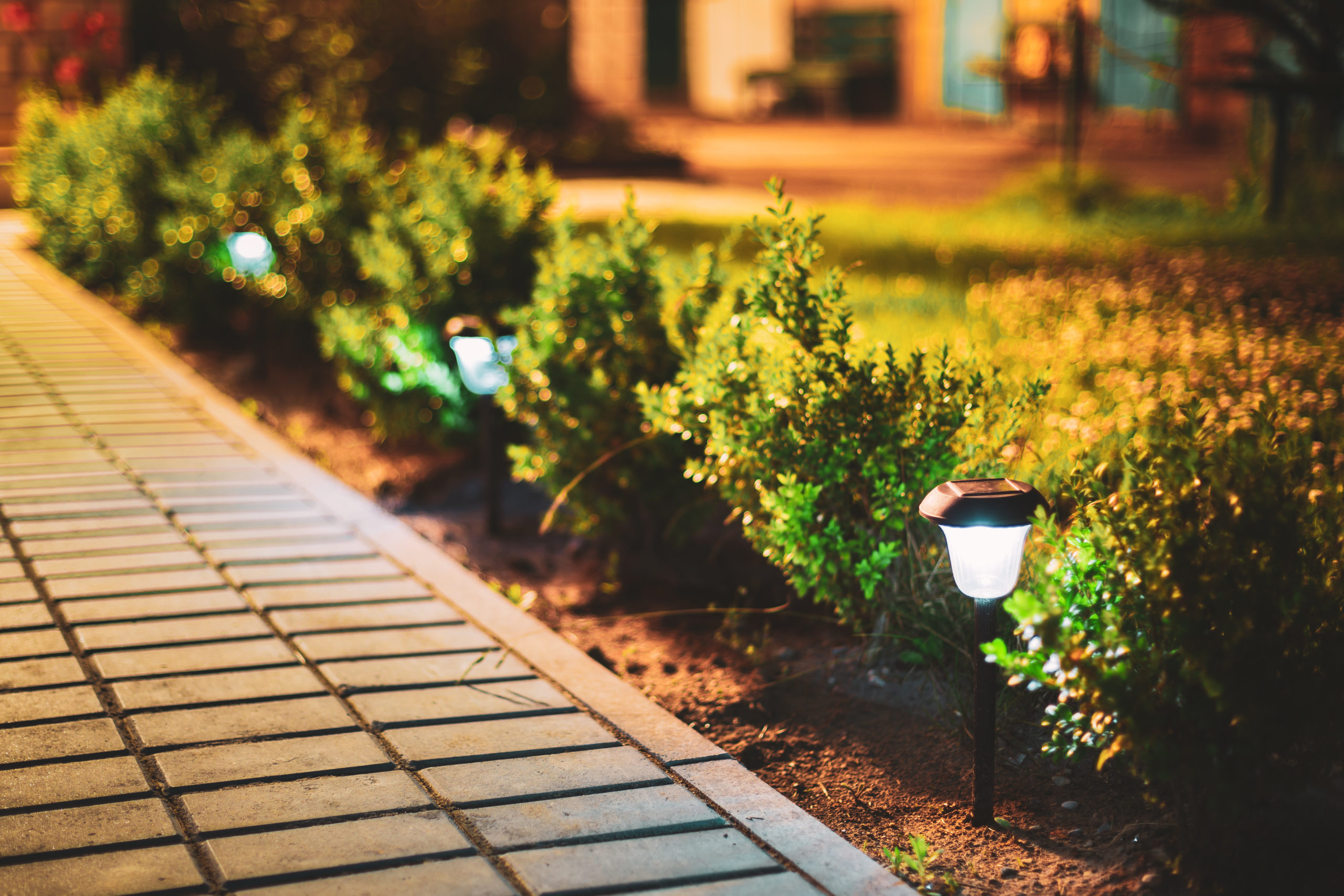
Atmospheric lighting is about something else entirely. It’s what makes a garden feel like a place worth being in after dark. Uplighting on a tree or an interesting plant creates drama and draws the eye. Low-level lights along a path give a sense of depth and direction. Festoon lights across a seating area create warmth and enclosure that transforms how the space feels.
The best garden lighting schemes do both. They make the space safe and usable while also creating something that looks beautiful after dark, in some cases more beautiful than it does in daylight.
Planning It Properly
The single biggest mistake with garden lighting is treating it as a retrofit. It’s something people think about once the patio is laid and the planting is in, and then discover that running cables and positioning fittings is far more disruptive and expensive than it would have been at the start.
If you’re planning any work on your garden, a new patio, a redesign, changes to planting, lighting should be part of that conversation from the beginning. Where do you want cables to run? Are there features you want to highlight? Do you want the seating area lit, or just the path leading to it? These questions are much easier to answer before anything is built than after.
Even if you’re not planning a major project, it’s worth mapping out what you’d want before doing anything. A loose plan means that if and when you do any groundwork, you can include ducting for cables without it becoming a separate job.
Mains, Low Voltage, Or Solar?
There are three main approaches to garden lighting and each has its place.
Mains-powered lighting is the most reliable and gives you the most options. It requires proper installation by a qualified electrician and cables need to be buried at the right depth, but the result is consistent, controllable, and can handle the full range of fittings, from subtle path lights to more substantial feature lighting. This is generally the approach for permanent, integrated lighting schemes.
Low voltage systems run from a transformer and are somewhat easier to install, though still best done properly. They’re a good middle ground for many residential gardens, more reliable than solar, and less involved than a full mains installation.
Solar lighting has improved considerably in recent years, but it comes with a significant limitation that doesn’t always get mentioned: the batteries. Most solar garden lights rely on small rechargeable cells that degrade relatively quickly, often within a season or two of regular use. As the battery capacity drops, the lights start cutting out earlier in the evening or failing to hold a charge on overcast days. In a West Midlands garden, where reliable sunshine isn’t guaranteed at the best of times, this can make solar lights frustrating to depend on. They work well as secondary or accent lighting where consistency isn’t critical, but for anything you’re counting on to be there every evening, mains or low voltage is a far more dependable foundation.
What To Light
This is where the fun is, and it’s worth thinking about it carefully rather than just buying a set of path lights and spacing them evenly.
Trees and large shrubs respond beautifully to uplighting. Positioning a fitting at the base and angling it upward creates interesting shadow patterns and gives the garden a sense of scale after dark. Even a relatively modest tree can become a focal point.
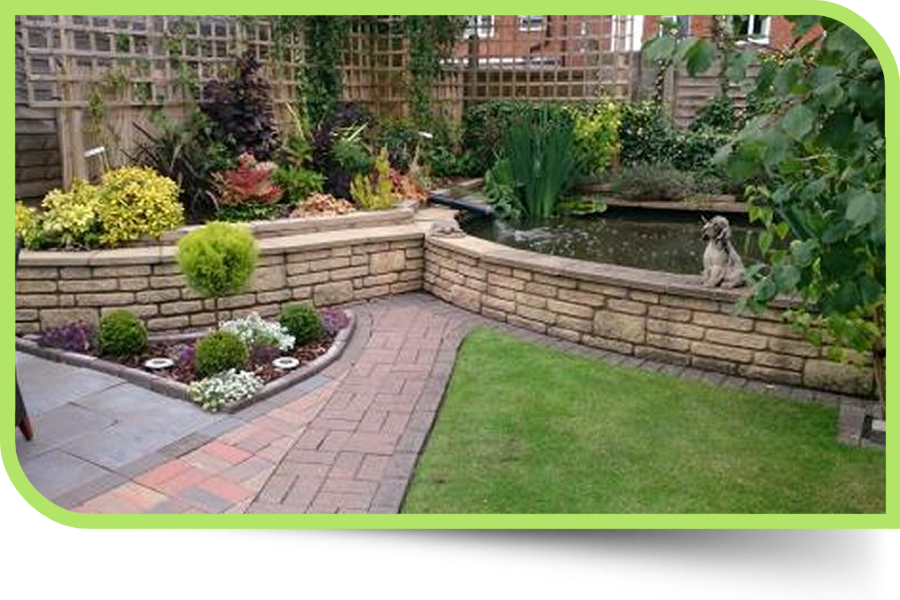
Water features, ponds, rills, small fountains, take on a different character entirely when lit. Submersible lighting in a pond, or carefully positioned external lights catching the surface, can be genuinely striking.
Seating areas benefit most from warm, diffuse light rather than bright, direct light. Festoon lights or overhead fittings that wash the space in a warm glow feel more inviting than a single bright spotlight. The goal is to feel like you’re in a room, not standing under a security light.
Paths and steps need clarity rather than drama. Low-level fittings that mark the route and illuminate where you’re putting your feet are more useful here than anything decorative.
A Note On Colour Temperature
This is a detail that makes a bigger difference than most people expect. Lighting is measured in Kelvin: lower numbers are warmer, more orange in tone, and higher numbers are cooler, tending towards blue-white.
For garden lighting, warm white in the range of 2700K to 3000K almost always looks better than cool white. It feels natural and inviting rather than clinical. Cool white can work in very contemporary spaces, but as a general rule, warmer is better for residential gardens.
The Wider Picture
Garden lighting is rarely talked about in the same breath as patios or planting, but it shapes how you experience your outdoor space more than almost anything else. A well-lit garden in June, with long evenings and warm temperatures, is a genuinely different place to be in than one that goes dark at dusk.
If you’re thinking about a garden project, whether that’s a full redesign or a more specific change, it’s worth having the lighting conversation early. We offer an online garden design consultation for £75 that covers the whole picture, including how light and space work together. For local projects across Stourbridge, Halesowen, Dudley, Wolverhampton, Birmingham and the surrounding area, get in touch for a free quote.